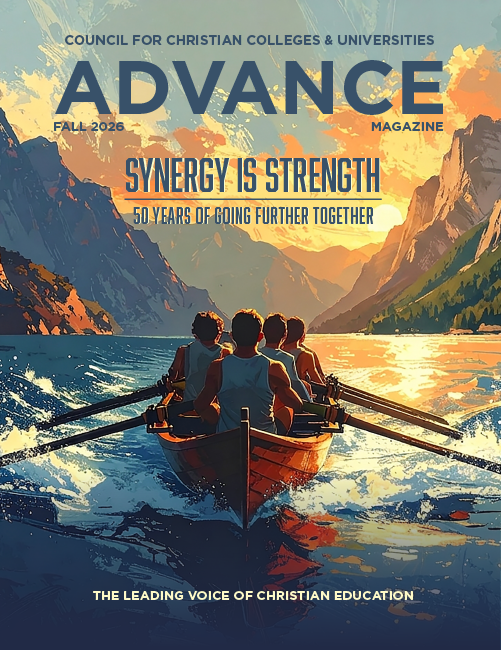
Magazine

Stewarding the Moment, Strengthening the Mission
Fall 2026
Dr. Noah J. Toly

Higher education in the United States is being remade before our eyes. Polarization, shifting government regulations, changing accreditation expectations, global conflict, a jagged demographic cliff, and the rise of artificial intelligence are reshaping academic programs, straining business models, and sending strategic plans back to the drawing board.
Our experience of this moment goes by many names – disruption, “the great upheaval,” VUCA (volatile, uncertain, complex, and ambiguous). Whatever we call it, navigating it will require unusual wisdom and focus.
That raises a fair question: amid so many urgent demands on our attention and resources, why should the CCCU and its members prioritize the integration of faith and learning now?
By the integration of faith and learning, we mean teaching, learning, and scholarship from a distinctly Christian perspective. It’s education that understands every subject in the light of God’s Word and God’s work in the world. But it doesn’t stop there – it invites academic insights into our conversation with our deepest Christian convictions in ways that also enrich our faith.
That may not sound like an answer to our biggest challenges, but three reasons make it indispensable in our current moment.
Integration Anchors Us in What Endures
The institutions we love were founded and sustained with great attention to the particularities of their own seasons of crisis and opportunity, and stewarding them today requires the same discerning attention to the particularities of our moment that their founders gave to theirs. So it is not only understandable – but basic stewardship – to pay attention to our changing landscape.
Even so, seasons of change should prompt us to anchor in our enduring purpose. For Christian higher education, that enduring purpose is reflected in the integration of faith and learning.
To some, this may seem like an odd claim. A programmatic emphasis on “integration of faith and learning” emerged only in the mid-twentieth century as an answer to a specific problem. Parts of the academy had walled off faith and parts of the church had walled off the life of the mind, impoverishing both. The integration of faith and learning meant to reconnect the two, equipping faculty trained at the highest levels of their academic disciplines with the theological depth, rigor, and sophistication to see those disciplines in biblical perspective.
At the same time, integration did not invent a new paradigm; it retrieved an ancient relationship. Taking every thought captive (2 Corinthians 10:5), testing all things and holding fast to what is good (1 Thessalonians 5:21), being transformed by the renewing of our minds (Romans 12:2) – recognizing that these biblical commitments are at the heart of our integration anchors our work not only in something more stable than our changing moment, but in something of eternal value that predates our founding and will outlast our institutions.
Integration Unites the Core Commitments of Our Institutions
Integration holds together our greatest purposes: mind-stretching learning and transformative Christian formation. It is not satisfied with devotions at the beginning of class or spiritual exercises bolted onto an otherwise standard syllabus. It is not a conventional calculus course plus chapel. Rather, the integration of faith and learning seeks to frame every disciplinary problem, contemporary challenge, artistic endeavor, and enduring question within the horizon of Christian teaching. For example:
- As we develop artificial intelligence, we draw upon biblical anthropology to ask what it truly means to be human.
- The doctrine of creation shapes how an economist weighs our experience of scarcity, how a biologist teaches the dignity of life, and how an artist portrays both beauty and brokenness.
- Christian ethics presses the engineer past “Can we build it?” to “How should we build it?” and “Why should we build it?”—and “Should we build it at all?”
At the same time, learning can inform, challenge, focus, and deepen our faith as we wonder at the ways that God’s grace is already at work in our fields of study while also discerning the flawed assumptions woven into them.
Integration Strengthens Christian Higher Education at Multiple Scales
Finally, a focus on the integration of faith and learning strengthens Christian higher education at multiple levels.
- For individuals, it refuses the divided life – thinking in one room and worshiping in another – and forms teacher-scholars and graduates who experience teaching and scholarship as discipleship.
- For institutions, it brings practices into alignment with what we profess, emphasizing the academic and spiritual character that distinguishes our institutions in the marketplace and building trust with stakeholders who need to see us invest in and excel at our distinctive Christian commitments.
- For the international movement, a shared commitment to the integration of faith and learning integration gives us something in common when disciplines, educational models, learner groups, theological traditions, cultures, and continents differ. Our shared practices of faith and learning can build community, open up partnerships, and strengthen Christian higher education around the world.
Integration is a Craft
The integration of faith and learning is urgent not despite the pressures of this moment, but because of them. When circumstances are volatile, we need what is stable; when uncertain, what is sure; when complex, what is fundamental; when ambiguous, what is clear.
But the fact that integration anchors us in enduring Christian commitments and practices does not mean it comes naturally. Integration – at the individual, institutional, or international levels – is a craft. It is something we can do well or poorly, something that requires intentional cultivation.
That is why the CCCU is investing directly in this work now. A new Center for Faith and Learning will build on and expand what many Christian colleges and universities have long practiced and are actively strengthening, equipping member institutions with the resources, relationships, and formation needed to master this craft for a new era. Because the first answer to a changing landscape is an enduring purpose, faithfully renewed.
Noah Toly serves as Senior Fellow for Faith and Learning at the Council for Christian Colleges & Universities, Special Advisor to the President at Calvin University, and Visiting Fellow at the Center for Public Justice. He served five years as Calvin’s Provost and Chief Academic Officer, partnering with faculty, staff, senior leaders, and trustees to advance Christian mission, shared governance, and long-term institutional health. His portfolio encompassed academic strategy, faculty affairs, student success, and athletics. Previously, he spent fifteen years on Wheaton College’s faculty, serving as Professor of Urban Studies and Politics & International Relations and founding director of the Center for Urban Engagement. He has served on the CCCU’s Chief Academic Officers’ Commission and holds degrees from Wheaton College and the University of Delaware, where he earned his doctorate in urban affairs and public policy. He and his wife, Becky, have three children and live in Grand Rapids, Michigan.
Related Articles
One Mission, Many Campuses
Christian Colleges Still Matter: Now They Must Prove It
Cultivating the Craft, Carrying the Vision
Magazine
View the current issue