About
Our Work and Mission
THE LEADING VOICE OF CHRISTIAN HIGHER EDUCATION
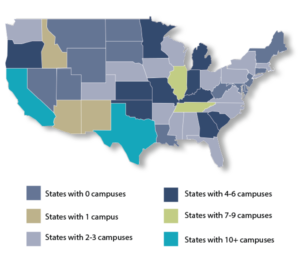
The Council for Christian Colleges & Universities is a higher education association of more than 170 Christian institutions around the world. Since 1976, the CCCU has served as the leading voice of Christian higher education. With campuses across the globe, including more than 130 in the U.S. and Canada and more than 30 from an additional 18 countries, CCCU institutions are accredited, comprehensive colleges and universities whose missions are Christ-centered and rooted in the historic Christian faith. Most also have curricula rooted in the arts and sciences. The CCCU’s mission is to advance the cause of Christ-centered higher education and to help our institutions transform lives by faithfully relating scholarship and service to biblical truth.
Christian Mission
We are committed to supporting, protecting, and promoting the value of integrating the Bible—divinely inspired, true, and authoritative—throughout all curricular and co-curricular aspects of the educational experience on our campuses, including teaching and research. We support a coherent approach to education in which the development of the mind, spirit, body, and emotions are seamlessly woven together in the quest not just for knowledge but also for wisdom.
Academic Excellence
Through an array of initiatives, we promote the development of high-quality academic research projects, provide opportunities for faculty to conduct innovative research with peers from other campuses, and provide administrators with opportunities to gain the most current information in order to lead highly successful campuses that employ best practices for student thriving and academic success.
To fulfill our mission and meet the needs of our institutions, we provide unique services for administration, faculty, students, and friends of Christian higher education in three pillars of strategic focus:
- Our Three Pillars of Strategic Focus
- Public Advocacy | As an effective and respected advocate for Christ-centered higher education both in the U.S. and around the world, we provide a unified voice to highlight the contributions of our institutions to the common good. We also advocate for the right of each CCCU institution to practice its sincerely held religious beliefs and to participate fully in the public square without penalty.
Learn more - Professional Development & Scholarship | We host numerous conferences for administrators to develop their skills, build connections with peer leaders, and be equipped in their work to provide a holistic, Christ-centered educational experience for students. We also invest in faculty development and scholarship through institutes and grants intended to help faculty excel in their scholarship and integrate faith into their discipline. Through the new Center for Faith & Learning, CCCU institutions also have access to a dedicated resource hub designed to strengthen faith integration across teaching, scholarship, vocation, and campus life. Our leadership institutes also play a pivotal role in ensuring that the pipeline of leaders in Christian higher education is filled with a diverse pool of highly qualified candidates.
Learn more - Experiential Education | CCCU GlobalEd is a collection of faith-integrated, off-campus study programs that foster intellectual, cultural, vocational, and spiritual growth. Our programs transform the way students experience the world and equip them to live out their Christian faith in today’s global society. More than 13,000 students have benefited from our academically rigorous, Christ-centered experiential education programs for the past 40 years.
Learn more
CCCU Institutions at a Glance
- AUSTRALIA
- CANADA
- DOMINICAN REPUBLIC
- GHANA
- HAITI
- HUNGARY
- INDONESIA
- ISRAEL
- JAPAN
- KENYA
- LITHUANIA
- NETHERLANDS
- NEW ZEALAND
- REPUBLIC OF KOREA (SOUTH KOREA)
- ROMANIA
- TAIWAN
- UGANDA
- UNITED KINGDOM
Our History
The CCCU was founded more than 40 years ago with a purpose that was simple to state but lofty in ideal: Create a broad association of Christian colleges that would support promotion and leadership activities for member schools and provide a unifying voice for Christian higher education in the public square.
At the same time, the Council’s founders launched the organization’s first faith-integrated, semester-long experiential study program: the American Studies Program in Washington, D.C. ASP’s launch laid a foundation for future transformative and immersive global off-campus programs, now known as CCCU GlobalEd, which have educated and transformed the lives of more than 13,000 students through experiential education rooted in scripture and the belief that faith can be integrated into all aspects of life in all locations around the world.
Since the CCCU was founded in 1976, we may have changed in size, in scope, in office location, and even in name, but we have always remained rooted in our mission: to advance the cause of Christ-centered higher education and to our help our institutions transform the lives of students by faithfully relating scholarship and service to biblical truth.
What Is Christian Higher Education?
The institutions of the CCCU share three basic educational commitments:
First, we integrate biblical truth not just into “spiritual” aspects of the institution but throughout the academic enterprise. Our professors pursue academic excellence because they are committed to God as the author of truth, and that truth has implications for every academic discipline. The classroom and the laboratory are just as much arenas of Christian integration as the college chapel.
Second, we are committed to the moral and spiritual formation of students. Education that instructs the mind without deepening the soul is not true learning. Our schools seek to develop students who, in the words of the Old Testament prophet, “act justly and love mercy and walk humbly with their God” (Micah 6:8). This requires not simply professional competence but wisdom, which is a sense of things in their proper relationship and a love for the right things. Our purpose is to form students of moral commitment who live out Christian virtues such as love, courage, and humility. This task gives meaning and coherence to every part of the academy, from the classroom to the fine arts studio, from the internship placement to the residence hall and the athletic field.
Third, we are committed to graduating students who make a difference for the common good as redemptive voices in the world. Our schools offer a wide variety of academic programs because we believe that Christians are called to use their vocations as vehicles to bring the good news of Jesus Christ to a fallen world. Our graduates are “hopeful realists” who recognize the brokenness of the world but believe that God has called them to work for its healing. As such, they play a redemptive and restorative role in the world as doctors, teachers, marketers, engineers, parents, soccer coaches, and in a host of other ways. In other words, we are private religious institutions that exist for the public good and contribute to human flourishing.
Value Proposition
Christian colleges and universities provide an affordable, high-quality education for students and are vital in educating first-generation and low-income students.
Download The Case for Christian Higher Education 2020
Download The Case for Christian Higher Education 2021
Download The Case for Christian Higher Education 2024
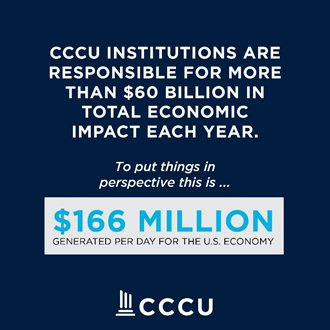
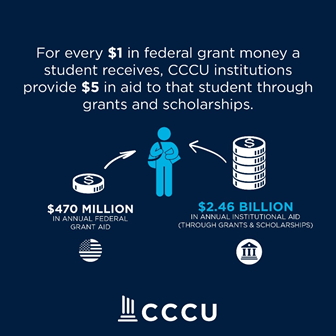
Economic Impact
Annual Reports
To fulfill our mission and meet the needs of our institutions, we provide unique services for administration, faculty, students, and friends of Christian higher education. Click the report to download.
Our Place in Higher Education
According to the National Center for Education Statistics, there are more than 4,300 degree-granting institutions of higher education in the United States. These include nearly 2,600 private institutions, just over 1,000 of which define themselves as religiously affiliated. Of those, 140 Christian colleges & universities in the U.S. have found common cause in the mission of the CCCU (as part of the CCCU’s broader membership of more than 170 Christian institutions around the world).
Leadership and Staff
President & Cabinet
Under the leadership of President David Hoag, the global team at the CCCU strives to advance faith and intellect for the common good.
See the CCCU President & Cabinet
Staff Directory
Our many programs and services are coordinated by a core team in Washington, D.C., and by the staff of each of our experiential education programs.
Board of Directors
Our board of directors provides leadership and vision central to the CCCU's mission.
See the CCCU Board of Directors
Commissions
The CCCU works closely with strong groups of volunteer leaders in key administrative positions on CCCU campuses. These groups, called commissions, advise the CCCU on relevant topics, assist with planning content and securing speakers for conferences, and work to connect and serve as a resource for colleagues in peer positions at CCCU institutions across the country.
Sponsorship & Advertising Opportunities
From sponsoring conferences and events to utilizing print, email, and website advertising opportunities, we provide a variety of ways for you to connect with key leaders on CCCU campuses.
Learn MoreAffiliations and Partnerships
The CCCU partners with a wide variety of organizations who all hold different roles in higher education, in religious freedom, and in Christian formation.
We are a member of the following organizations:
American Council on Education (ACE)
Correctional Education Association (CEA)
Council of Independent Colleges (CIC)
Evangelical Council for Financial Accountability (ECFA)
Evangelical Immigration Table (EIT)
International Network for Christian Higher Education (INCHE)
National Association of Independent Colleges & Universities (NAICU)
Washington Higher Education Secretariat (WHES)
We partner on a variety of initiatives with organizations like these:
America’s Christian Credit Union
Association of Business Administrators of Christian Colleges
Australian Christian Higher Education Alliance
Christian Community Credit Union
Christian Higher Education Canada (CHEC)
National Association of Evangelicals (NAE)
National Hispanic Christian Leadership Conference (NHCLC/CONEL)
CCCU Awards
We regularly recognize individuals who have championed the cause of Christian higher education.
| Award | Description |
|---|---|
| Champion of Higher Education Award | The Champion of Higher Education Award is presented to individuals who have demonstrated strategic vision and unparalleled dedication to the field of higher education. |
| Champion of Vision Award | The Champion of Vision Award is presented to individuals who have championed partnerships to promote the flourishing of CCCU institutions and their surrounding communities. |
| John R. Dellenback Global Leadership Award | The John R. Dellenback Global Leadership Award is presented to individuals who have made outstanding contributions to Christian higher education through scholarship, writing, and public influence. |
| Mark O. Hatfield Leadership Award | The Mark O. Hatfield Leadership Award is presented to individuals who have demonstrated uncommon leadership that reflects the values of Christian higher education. The award was established in 1997 in honor of Senator Hatfield, a longtime supporter of the Council. |
| Philanthropy Award | The Philanthropy Award is presented to individuals who have made significant philanthropic contributions to the work of the Council for Christian Colleges & Universities and its membership. |
| Young Alumni Award | The Young Alumni Award is presented to individuals who have graduated within the last 10 years and have achieved uncommon leadership or success in a way that reflects the values of Christian higher education. |
Support Us
Join us in our work to advance faith and intellect for the common good.
Support CCCUContact Us
|
Inquiry |
||
|
General |
council@cccu.org |
|
|
Research |
||
|
Media Inquiries |
media@cccu.org |
|
|
Conferences and Events |
conferences@cccu.org |
|
|
Membership Application |
development@cccu.org |
|
|
Advocacy |
||
|
Development |
development@cccu.org |
|
|
Tuition Waiver Exchange Program |
development@cccu.org |
|
|
Off-Campus Study Programs |
|
|
|
Career Center |
|